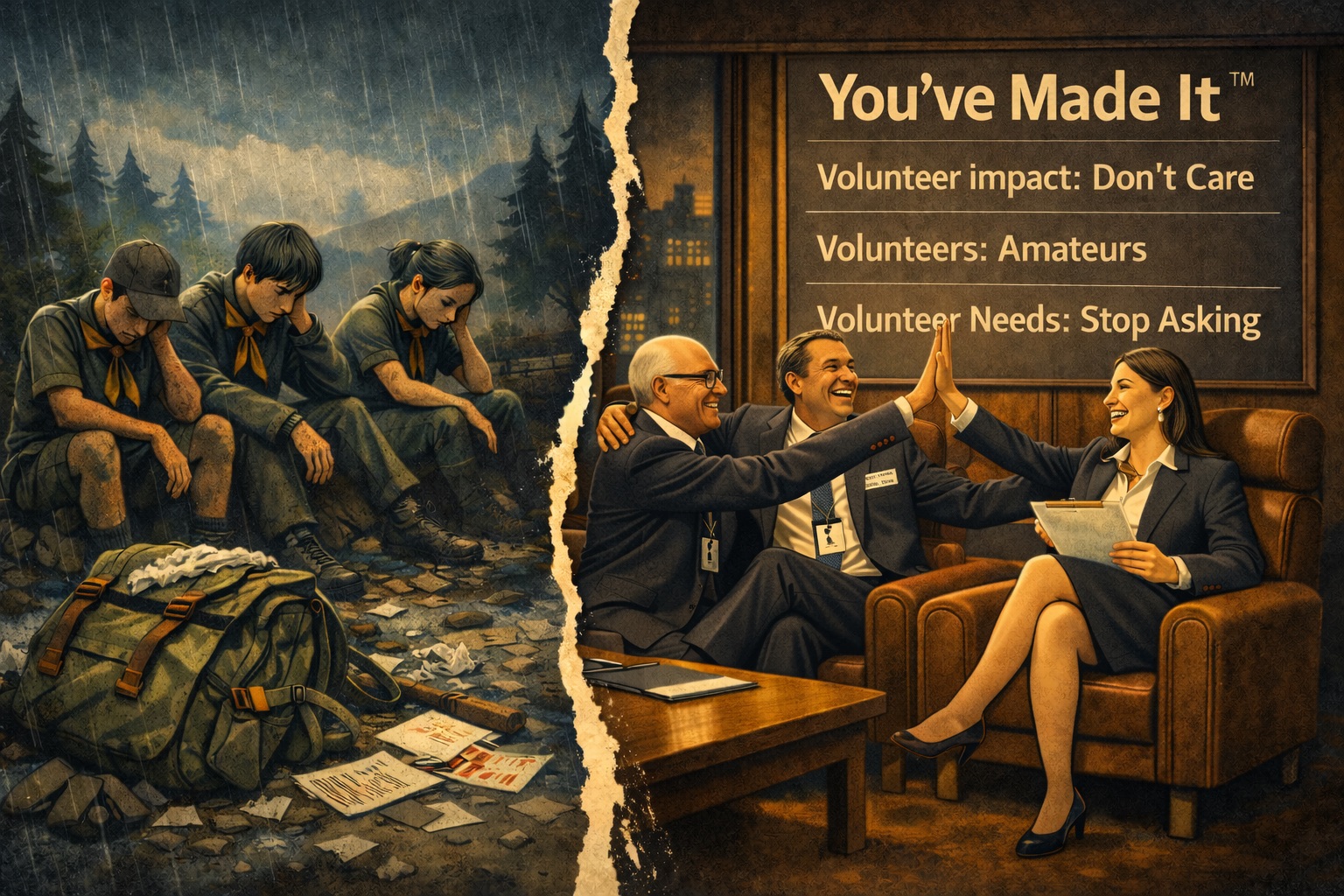
In any healthy nonprofit, the professional staff exists to serve the mission. Their value is measured by their effectiveness, their innovation, and their ability to deliver results for the movement.
For decades, the Boy Scouts of America (why SA is a bad name) has operated under a different set of rules, an employment model that functions like a medieval guild.
I call it the commissioned-bureaucrat system.
On the surface, it looks like a brotherhood of youth-service experts. But peel back the layers, and you find a career-protection racket. It is a system designed not to identify the best talent but to filter for compliance. It is a structure where loyalty to the bureaucracy outweighs competence, and where the primary objective shifts from growing the movement to preserving the status quo of the employees.
To understand why Scouting struggles to adapt to the modern world, we have to look at who is running it and the archaic system that put them there.
A primer on BSA’s employment lines
BSA has two categories of permanent employees: administrative and commissioned.
Administrative employees do customary corporate functions, like HR, technology, marketing, and finance.
The other employment line is the commissioned-bureaucrat system. This is generally for bureaucrats who directly work with the program and their chain of command.
Becoming commissioned
Part of becoming a commissioned bureaucrat is a training that’s about a week, typically at BSA’s Irving, TX headquarters. Once commissioned, the employee is essentially ordained, like how ministers are ordained in churches.
That framing isn’t accidental. Commissioning is treated as a credential that unlocks access, authority, and advancement across program-side bureaucrat roles.
The system’s phases
The commissioned-bureaucrat system has three phases:
- Hazing: This is the District Executive role, an assignment heavily focused on numbers, called PDS goals. It is brutal, with low pay and often 60 to 80 hours a week. This phase runs off all but those most loyal to the bureaucracy. Those with leadership potential or valuable, distinct skills often exit BSA early.
- Middle career: These are typically middle-tier bureaucrats. While often less brutal than the DE role, loyalty to the bureaucracy continues to be tested and rewarded. Those with leadership talent and valuable skills continue to be pushed out or sidelined, further shrinking the pool to bureaucrats optimized for internal compliance.
- You’ve Made It™️: After enough years of proving one’s loyalty to the bureaucracy, remaining bureaucrats enter a “good ol’ boys” club. Such bureaucrats often land relatively well-paid, cushy, or prestigious roles. You’ve Made It™️ status often starts with the Scout Executive (council CEO) role.
This is not a leadership pipeline. It is a career-protection system for bureaucrats.
Closed shop
BSA props up the commissioned-bureaucrat system through extensive role gating. It’s essentially a closed shop. In addition to protecting careers of bureaucrats, it eliminates competition, starving BSA of diverse talent.
Most of BSA’s permanent, full-time, professional roles are gated to commissioned bureaucrats, including1:
- District Executives (DEs), an entry-level sales and customer-service role that also does many miscellaneous duties
- A “year-round program position” or a “unit growth executive”
- Any other council or national-organization position that the national CEO (Chief Scout Executive) declares is gated2
- Any council position supervising a commissioned bureaucrat
- Council CEOs (also called Scout Executives)
Because of this gating, councils can only fill program-side roles from inside the commissioned-bureaucrat pipeline. Even though national has a higher percentage of non-commissioned employees3, the commissioned-bureaucrat system still exerts outsized influence as it controls the feeder pipeline for program-related jobs and for upper-tier bureaucrat roles.
This kind of role-gating doesn’t just protect jobs. Because it concentrates power and decision-making inside a bureaucrat caste, it reinforces institutional capture. I unpack the governance mechanics of that capture in BSA excludes the movement from governance.
Career protection
The implied promise for You’ve Made It™️ bureaucrats is lifetime employment. This promise is conveyed during commissioning, when bureaucrat-ordinands are paraded through the Chief Scout Executive’s office. Multiple commissioned bureaucrats have independently told me that the message is clear: Stay loyal, and you will be protected. Stay loyal long enough, and you may rise to the top.
Whether stated outright or conveyed by tradition and incentives, the result is the same: a caste for the most loyal bureaucrats, where protection trumps accountability.
Unsuited to roles
The extensive gating, career protection, preference for loyalty over competence, and bias toward internal compliance means many roles are filled by bureaucrats unprepared to succeed.
Notably, many of BSA’s top corporate-leadership roles are occupied by career bureaucrats. This creates a structural mismatch. The talents needed to thrive as an executive—vision, courage, strategic clarity, and a service posture toward the movement—are not talents that the commissioned-bureaucrat system values.
That mismatch is why the halo product of the commissioned-bureaucrat system—the Chief Scout Executive (national CEO)—has always been a weak leader.
When your system rewards caretaking, compliance, and careerism, you will reliably surface caretakers, compliant managers, and careerists. These are yes-man bureaucrats, not competent leaders.
Protecting bureaucrats from accountability
A function of the closed shop is protecting careers of poorly performing You’ve Made It™️ bureaucrats.
Stories abound of the national organization protecting careers by warehousing failed You’ve Made It™️ bureaucrats in low-value roles until they can be placed back into a council. Not by coincidence, these low-value roles are often difficult to measure for impact, such as “Relationship Manager”. Such positions, where outcomes are vague, timelines are elastic, and accountability is easily blurred, are perfect for low-performing bureaucrats.
Sometimes national instead orchestrates lateral transfers of failed-out You’ve Made It™️ bureaucrats to equivalent roles in other councils. This preserves the bureaucrat’s career, not the mission.
Some allege this culture changed after the 2020 layoffs. I don’t buy it. Just recently, we’ve seen the same old pattern: a council CEO alienated volunteers, stunning them with a massive increase in bureaucracy-preservation fees. He then piloted his council’s fundraising to a seven-figure loss. Predictably, the good ol’ boy network saved his bacon: he failed over to a You’ve Made It™️ bureaucrat friend’s council, resurfacing as–wait for it–the lead fundraiser!
Valuing protection over competence or foments a bad culture: disdain for the movement, tolerance of poor performance, and reflexive insulation of bureaucrats from consequences.
When careers must be protected at all costs, the organization cannot learn. When the organization cannot learn, it cannot change. And when it cannot change, it cannot survive.
What this system costs BSA
This system taxes BSA in several ways:
- It drives away talent. People with leadership chops and modern skills leave early because the incentive structure punishes them.
- It confuses ends and means. Fundraising and internal career preservation become the product. The movement is just a pretext.
- It creates a leadership vacuum. The top tier is optimized for not rocking boats, not leading change, just for saying yes.
- It undermines volunteer trust. Volunteers sense when they are being managed, not served.
- It institutionalizes mediocrity. The system selects for survival inside the system, not for results in the real world.
The net of these harms is over 75 years of neglect of the programs and culture. No wonder the movement is tanking!
These taxes are not limited to the professional side. Remember how the commissioned-bureaucrat system captured the organization? Those who rise in volunteer ranks usually do so through extensive fealty to the capturers–the commissioned bureaucrats. In other words, volunteers above the unit level are strongly encouraged to take on the culture of the bureaucrats, where prestige and protection of the volunteer’s appointment are the main aims. Seen as a threat, competent, high-performing volunteers are suppressed or not considered.
What BSA should do instead
If BSA wants a future, it must break the closed shop.
Here are pragmatic steps:
- Open hiring for all roles. All employees will be hired based on qualifications. While experience inside Scouting can be a plus, it is no longer a bludgeon to exclude external candidates.
- Eliminate the DE-hazing funnel. No role will be a brutal loyalty test for new employees. All employees are treated with dignity and value.
- The job is to provide value to the movement. All professional roles must create value for unit-level volunteers, the ones delivering the program.
- Enforce accountability. When people fail in a senior role, the default response must no longer be, “transfer them somewhere else”.
- Abolish commissioning. Some roles may retain a required training component, but this is just an onboarding credential for a specific job family. No longer is it a skeleton key that lets bureaucrats control the movement.
BSA’s future depends on leadership, accountability, and openness. The commissioned-bureaucrat system is engineered to suppress all three. It must be abolished.
- All of this is defined in Rules and Regulations of the Boy Scouts of America, Oct. 28, 2025. ↩︎
- Ibid. See Employment of Professionals subsection, Rules and Guidelines sub-subsection, page. 16. ↩︎
- I am inferring this as a good deal of national’s functions are not in program delivery. Some examples include HR for all councils, IT for the entire organization, Scout Shops, and high-adventure bases. ↩︎
Leave a Reply